A fleet list built for real trucks, not just cargo boxes
The Vehicles screen holds every truck your account plans loads for, split by type — rigid, or tractor & semi-trailer — with cargo space, axle-group count, empty weight, maximum total weight and payload shown side by side.
Payload here is the maximum total weight less the empty weight, computed automatically from what you enter, so there's no separate number to keep in sync by hand.
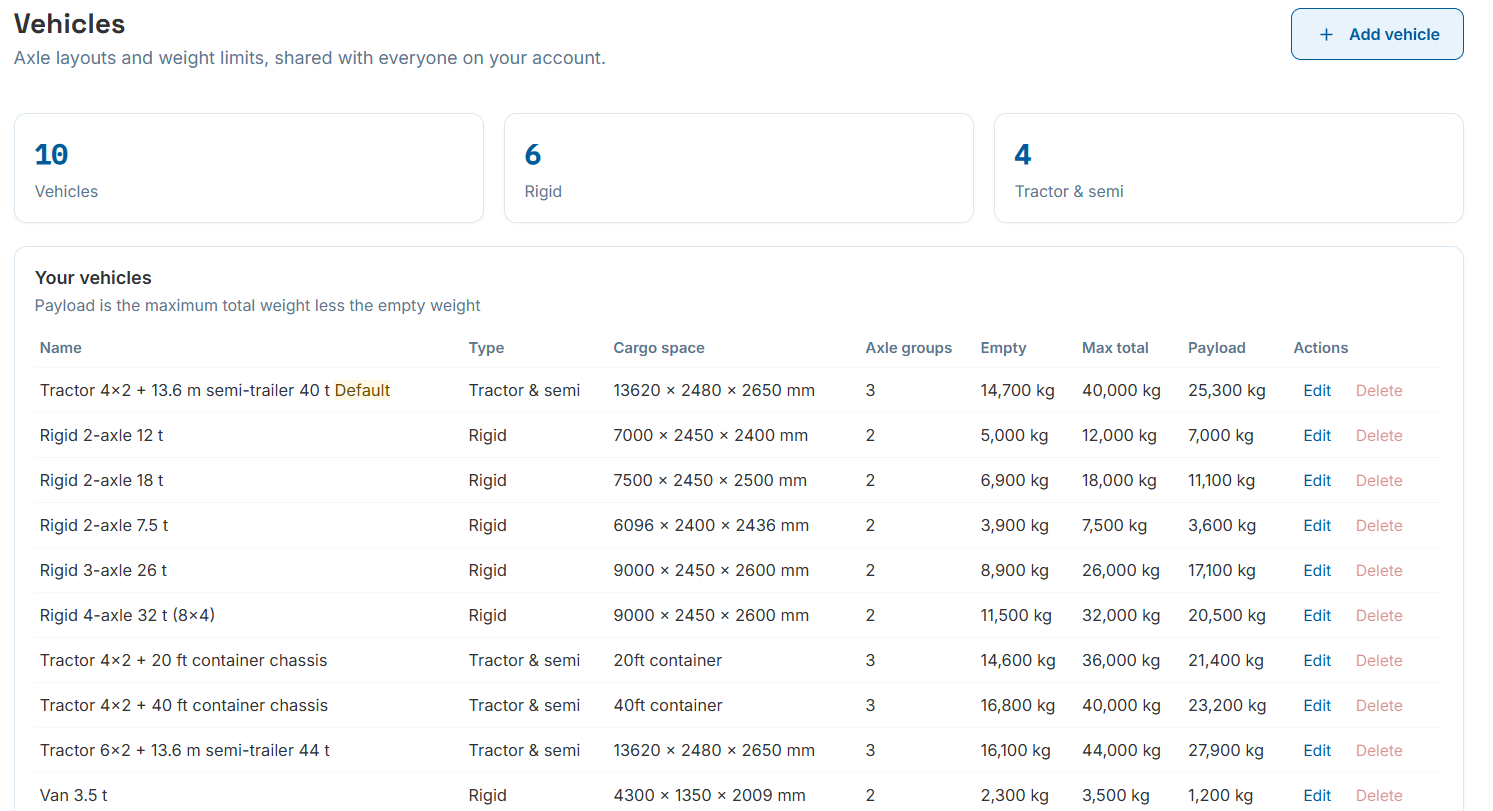
Master Data › Vehicles — 10 vehicles across rigid and tractor-and-semi types.
Two ways a vehicle carries cargo
A vehicle either has its own body — a rigid truck, van, curtainsider or box semi-trailer with fixed inside dimensions — or it carries a container on a skeletal chassis, where the container itself is the cargo space.
For a chassis, you also record a deck rating: what the floor itself is built to carry. Leave it empty unless you have a real figure, since the maximum total weight limit already caps the load and the lower of the two always applies.
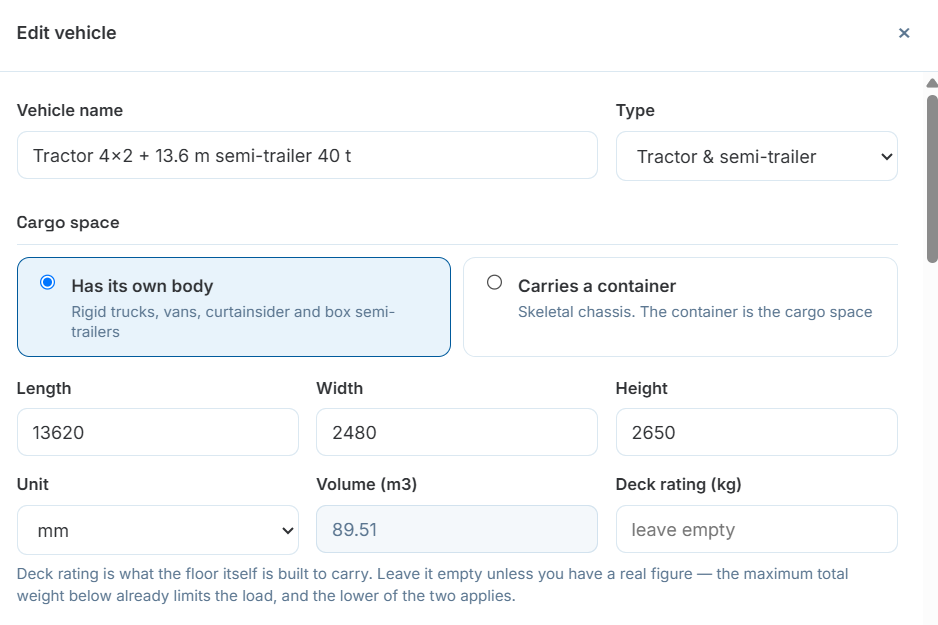
Choosing how a vehicle's cargo space is defined.
Positions on the chassis, not just a box
Clearance to leave works exactly like it does for containers — closed end, door end, left, right and top, always in millimetres. What's new here is the layout diagram: steering axle, drive axle, kingpin and trailer axle positions are plotted along the vehicle, measured from the closed end of the load space.
This is what lets the engine reason about where weight sits along the whole rig, not just inside the trailer box.
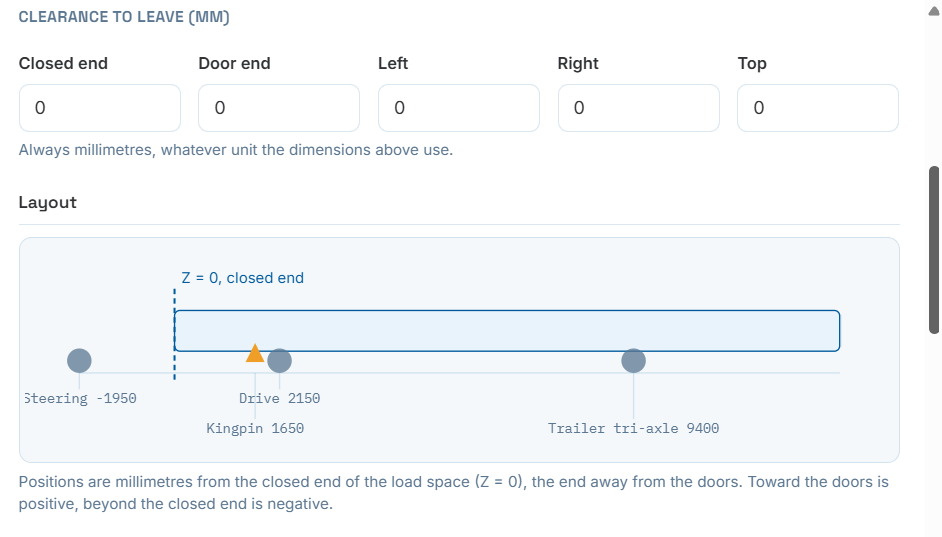
The layout diagram plots every axle and the kingpin along the vehicle.
Kingpin position and axle-group limits
For a tractor-and-semi, kingpin position and the share of weight reaching the steering axle (typically 10–25% of the tractor wheelbase) capture the geometry that actual axle-weight law cares about.
Axle groups — a tandem or tri-axle counts as one group, entered at its centre — each get a name, role (steering, drive, trailer), position, empty weight and maximum weight.
- Kingpin position is positive on curtainsider, box, reefer and container-chassis trailers where the cargo floor runs forward over the fifth wheel.
- It's negative only on a drop-deck or low-loader whose neck isn't loadable.
- Add as many axle groups as the vehicle actually has — steering, drive, and one or more trailer groups.
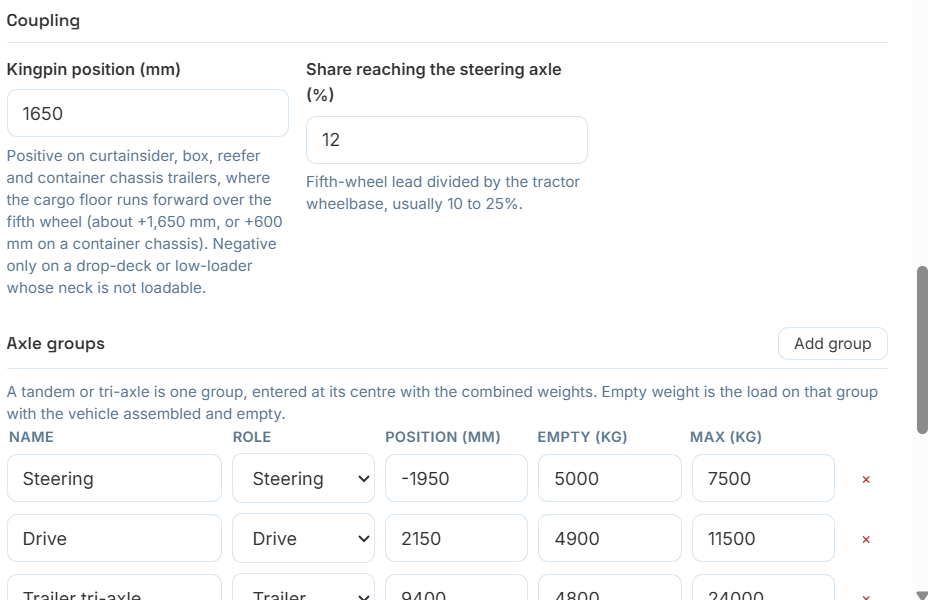
Coupling geometry and the axle groups table.
Empty weight, payload and the limits that keep a load legal
Extra weight carried covers anything not already in the empty weights above — an empty container riding on a skeletal chassis, for example. Maximum total weight and minimum steering-axle share round out the legal limits the engine checks against.
Empty weight and payload are computed and shown live, and any vehicle can be marked as the default used for new calculations.
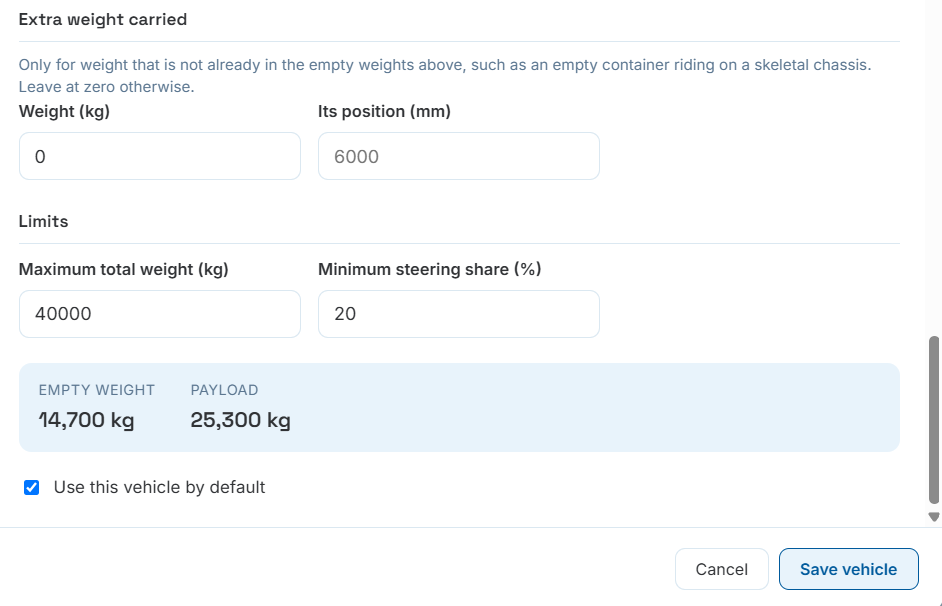
Limits and the resulting empty weight and payload.